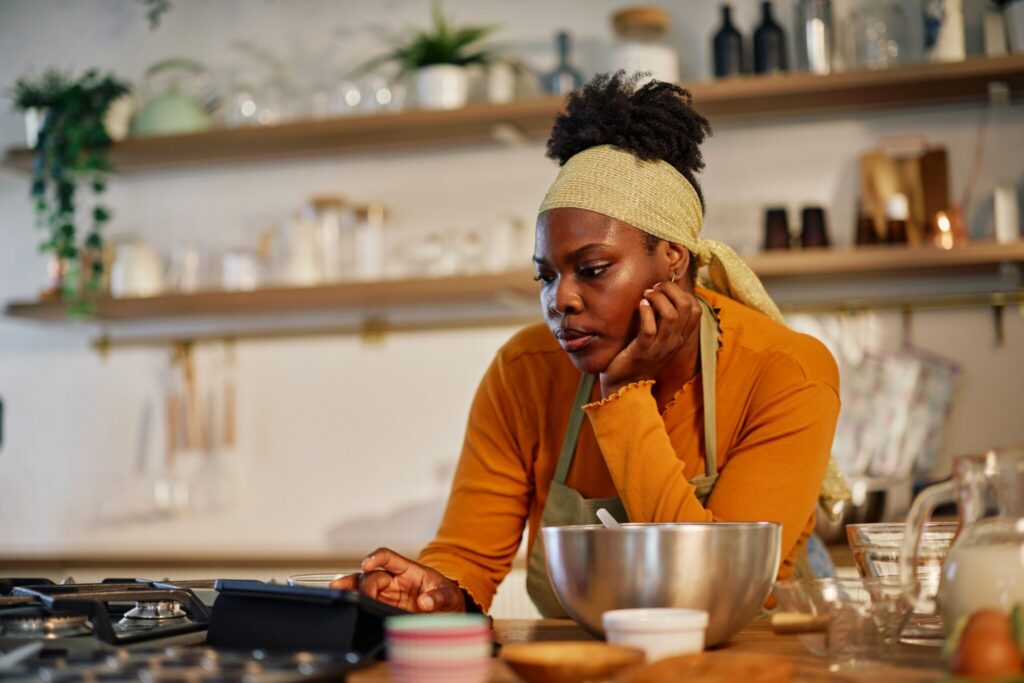
The cookies come out at 9 p.m., and the second shift starts after that. Someone has to print a sheet of labels: product name, ingredient list, an allergen line. In Michigan, the label may also carry the street address of the home bakery that made them. Nobody films that part for Instagram.
A home bakery looks like a baking job. On paper it is closer to running a small, regulated manufacturer out of a room that also has to make dinner. The baking is the visible hour. The rest is orders, packaging and state rules that decide what can be sold, to whom and how much.
A home bakery order starts in the inbox
Before a custom order is a task, it is a message thread. It covers the date, the flavor, the quantity, the price and a pickup window. Then comes the inevitable follow-up asking whether the frosting can match a napkin. All of it happens before anyone buys flour. None of it is billed by the hour.
Every new sales channel adds steps. In California, a Class A registration covers direct sales to the end customer in person, by mail or through third-party delivery, according to Orange County’s health agency. Selling to shops that resell the food takes a separate Class B registration. Shipping a box is allowed, then. It also means packing for transit, tracking the parcel and answering for whatever the courier did to it.
The label is a small legal document
This is where kitchen work turns into compliance work. Michigan’s cottage food statute requires ingredients listed in descending order by weight, plus a name and address. The state agriculture department’s labeling guidance specifies the home kitchen’s physical address; a post office box won’t do. The alternative is a voluntary registration with Michigan State University’s Product Center, which lets a baker print a registration number and phone number instead.
Allergens add another moving list. Federal law recognizes nine major food allergens. Sesame became the ninth on January 1, 2023, under the FASTER Act, signed in April 2021. Where a state’s label rules track that list, a sesame topping on one product means a new label for that product, and probably a new cleaning step.
Sales caps decide how big the kitchen can get
Most rules for home bakers sit in state cottage food laws, and the ceilings vary widely. California’s statute sets base caps of $75,000 in verifiable gross annual sales for Class A operations and $150,000 for Class B. Those are starting figures. The state adjusts them for inflation every year, so the limits a California baker works under in 2026 are the adjusted amounts, not these. The same law allows one full-time equivalent employee, not counting family or household members.
Texas moved more recently. Under SB 541, effective September 1, 2025, the state’s annual gross sales limit rose from $50,000 to $150,000, with inflation adjustments after that. That account comes from the Farm and Ranch Freedom Alliance, an advocacy group that campaigned for the change.
Note the word “gross” in both laws. A cap on gross sales limits revenue, not profit. Butter, eggs, boxes, labels, delivery fees and the baker’s evenings all come out of that number before anything counts as take-home pay. Hitting the ceiling and earning a living under it are separate milestones.
Where the rules stop and the hours begin
Cottage food laws are precise about some things: which foods qualify, which words go on the label, how much a kitchen may sell. They don’t count hours. No statute measures the time spent answering messages, re-baking a cracked batch or waiting by the door for a pickup that runs 40 minutes late. That labor is real whether or not a rule covers it, and the same gap shows up in the math behind a viral side hustle video.
That makes the label on the lid a slightly odd document. The allergen line, the weight-ordered ingredients and, in Michigan, perhaps a home address are the only pieces of the paperwork a customer ever holds. Each one was typed, checked and printed at the kitchen table after the oven went cold.
Rules and sales caps are as described in the linked sources at publication in November 2026. California’s figures are statutory base amounts before annual inflation adjustment.