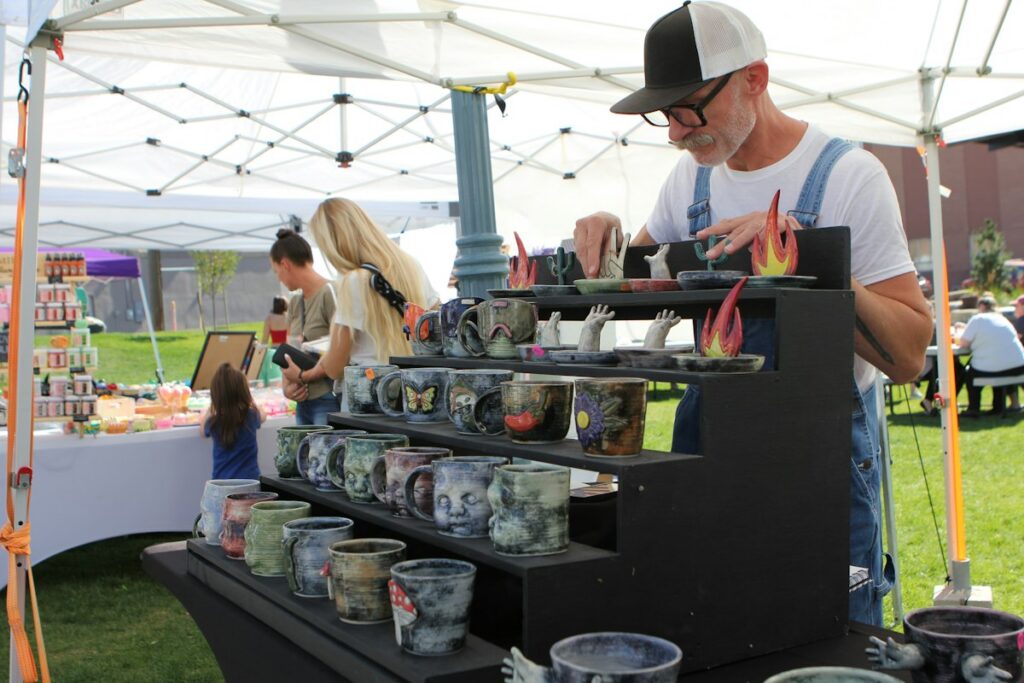
The photo of a market table tends to be taken around 11 a.m.: mugs in tidy rows, a hand-lettered price card, three people waiting to pay. It leaves out the 6 a.m. van load, the tent weights, the float of small bills and the Sunday-night count to see which glaze sold out and which one rode home again. Weekend craft markets get filed under charming. For the people behind the tables, they work more like a lab with a cover charge.
The cover charge arrives first
Organizers price a stall in roughly two ways, and the choice decides who absorbs a slow day. Crafty Wonderland lists a 5-by-10-foot space at $425 for its December 11 to 13, 2026 holiday market: three days, one flat price. Applying costs a nonrefundable $10, which is credited toward the booth if the maker gets in. Rejection is cheap. Backing out after acceptance is not. A cancellation within the refund window comes back $50 lighter.
The kit for Renegade Craft‘s fall 2026 fair in Chicago’s Wicker Park shows the other model. Its booths carry set prices, but food trucks pay 15% of sales plus a $200 deposit up front. A flat fee leaves the seller alone with a rainy afternoon. A percentage shrinks along with a bad day’s sales and takes its slice of a good one.
The arithmetic of a craft market table
Take an illustrative $40 ceramic bowl paid for by tap. Square lists in-person card payments at 2.6% plus 15 cents on its free plan as of November 2026, so that sale costs $1.19 to process. Assume, again for illustration, that clay, glaze, firing and packaging eat 40% of the price. Each bowl now leaves about $22.81. Covering Crafty Wonderland’s $425 booth takes 19 of them. That comes before parking, gas, a display rack or a single paid hour of the maker’s time.
The paperwork is labor too. Renegade’s Chicago kit gave accepted vendors five days, July 30 to August 4, to pay or lose the spot. It wanted documents by August 10 and put the risk of missing permits at onsite inspections squarely on the vendor. Nobody photographs the permit folder.
Repeat customers are the slower payoff
The best-documented case for market regulars comes from food, not crafts. A 2015 shopper survey at the Dane County Farmers’ Market in Wisconsin found that 90% of attendees were repeat customers. The main reason they gave for coming was that it made a fun outing.
That finding travels only so far. A weekly produce market builds habits, while a craft fair that pops up twice a year has to manufacture them. For a maker, the booth may work partly as advertising. A shopper who pockets a card in September and orders online in December appears in nobody’s booth tally. Whether that later order ever arrives is the variable no fee schedule can price.
A proving ground, not a paycheck
In the UK, at least, the income itself often sits inside a bigger patchwork. The Crafts Council heard from more than 1,000 makers in a September 2024 survey. It describes the sector as increasingly shaped by “portfolio makers,” people who earn some, but not all, of their income from making.
A web shop flattens shopper behavior into a conversion rate, and a market shows the live version. A seller can watch which price makes someone set an item back down, which color gets picked up first and which question comes up five times before lunch. The cost is weeks of production, a day standing in a tent and a guess at how much stock to pack. Guess low and the best seller is gone by noon. Guess high and the van is heavier on the way home.
The booth fee buys a few hours of foot traffic. What sellers are really paying for is the moment a stranger says “I’ll come back,” and the long wait to learn whether they meant it.
Fees and dates are as published by the organizers and Square for their 2026 terms.