The most valuable hours at an art fair are the ones the public never sees. In October 2026, before Art Basel Paris opened to ticket holders, galleries were already reporting sales from its Avant Première, an ultra-VIP session held ahead of the regular VIP days. Gladstone reported a Victor Man painting at $1.3 million and Wangechi Mutu works at $325,000 each. On the Pace Di Donna Schrader stand, a Modigliani carried a $100 million price. How an art fair makes money comes down to two questions. The first is who paid for the walls. The second is who was allowed in first.
The art fair is a landlord, and galleries are the tenants
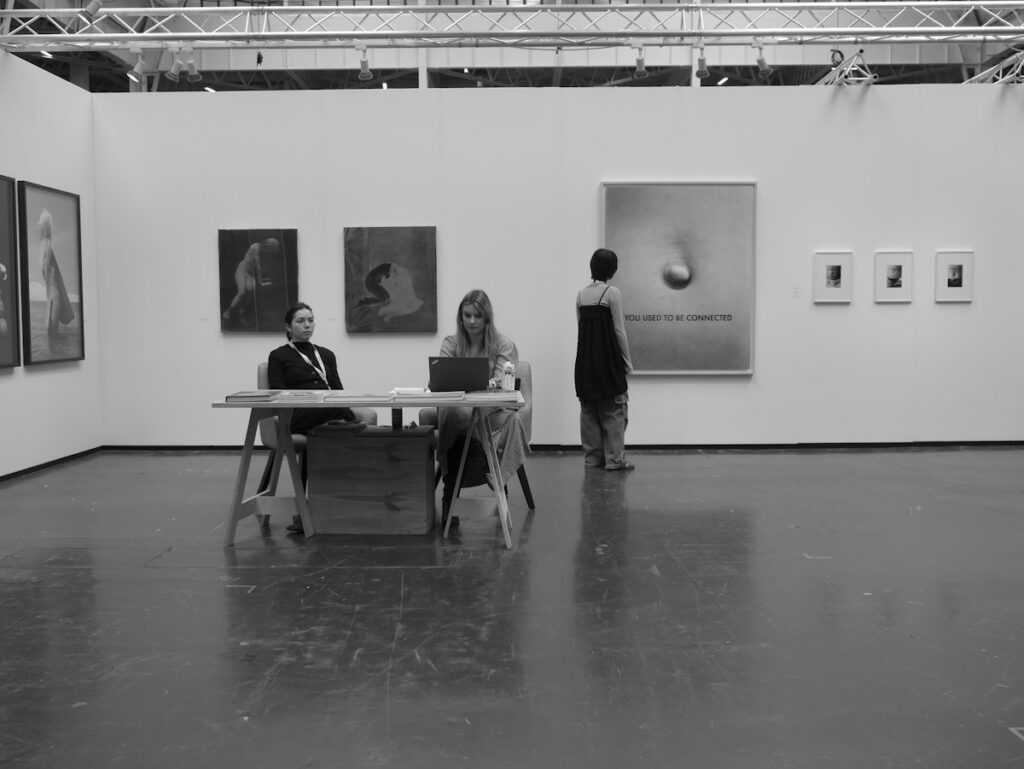
The fair does not sell the art. It rents space to the galleries that do, and the unit of rent is the booth, priced by the square metre. When Art Basel moved its Swiss fair to a sliding scale for the 2019 edition, it replaced a flat CHF 830 per square metre. The smallest main-section stands were set at CHF 760 and the largest at CHF 905. The idea was that bigger galleries would carry more of the cost so younger ones could carry less. Current rate cards have not surfaced in public reporting. Read those figures as a 2018 snapshot of how the pricing works, not as this season’s price.
Rent is only the first line of the invoice. Walls, lighting, crating, shipping, insurance, flights and hotels for staff all come after it. In a 2025 survey of 56 galleries by the firm First Thursday, 46% said a single fair cost them more than £30,000. Within that, 24% put the bill between £50,000 and £100,000. And 31% said they planned to do fewer fairs.
Why galleries keep paying
The buyers keep coming. The Art Basel and UBS report published in 2026 found that fairs accounted for 35% of dealer turnover in 2025, their highest share since 2022. Mid-size dealers relied on them most. The share of their sales made at fairs rose from 29% to 36%.
The authorship is worth noting. The research comes from Arts Economics and is based on dealer surveys. The report itself is published by the fair company together with its banking partner. Both things hold at once: the numbers are survey research, and the choice to publicize them belongs to a business that rents booths.
Selling the queue
Broadly, a fair earns money from three directions. Galleries pay for space, visitors pay for tickets, and sponsors pay for their name on the event. The calendar holds all three together. Art Basel Miami Beach is scheduled for December 4 to 6, 2026. Before that come two invitation-only preview days on December 2 and 3. On the public days, entry takes a ticket or an invitation. UBS is listed as Global Lead Partner.
What follows is interpretation, not documented fact. Each new early tier, such as the Avant Première in Paris, makes the hours behind it a little less rare. Public tickets can be sold in quantity. The earliest invitation has no public price at all, and that absence looks like part of its value. A gallery spending five figures on a booth is largely paying to stand in front of a small number of serious buyers before anyone else arrives. The later crowd supplies the sense of occasion. It is not the customer the booth was built for.
What the reported prices can and can’t say
The sales figures that come out during a fair are typically supplied by the galleries, often while the fair is still running. Some galleries give exact prices. Others give a range, or simply say a work went to a museum or a private collection. These are self-reported numbers, not audited records. They show reliably what a gallery wanted the market to hear that week. They are not an independent ledger of what changed hands.
The timing is revealing too. Before the Paris fair opened, ARTnews reported that David Kordansky Gallery said several holds had turned into sales. A hold is a reservation placed before the paperwork. When one converts that early, the fair is less the place where a deal begins than the place where it gets signed off. By the time a day-ticket holder reaches the stand, the most important thing to have happened at that booth may be the small sold dot beside the label.
Sale prices are as reported by galleries to the publications cited, on the dates given.