Somewhere near the pharmacy register there is usually a bin of tiny things: shampoo the length of a thumb, toothpaste that could vanish in a coat pocket, a deodorant that looks like a sample of deodorant. Shoppers grab two, maybe three, and move on. Nobody lingers. That’s the charm of travel-size products, and it’s also why their price per ounce rarely gets the scrutiny a family-size jug of detergent does.
A size set at the checkpoint
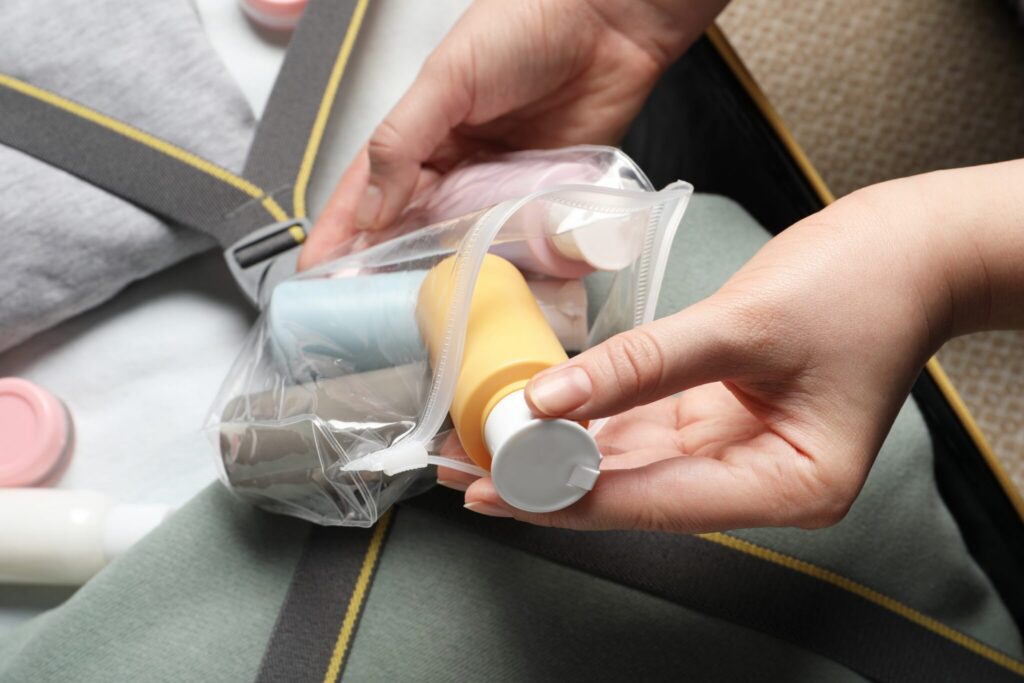
The dimensions line up suspiciously well with airport security. TSA’s explainer of its 3-1-1 rule sets the terms for carry-on liquids, aerosols, gels, creams and pastes. Each one goes in a container of 3.4 ounces (100 milliliters) or less, and the whole collection has to fit in a single quart-size bag. Plenty of minis come in well under that ceiling. That makes sense once you picture the toothpaste, the shampoo and the sunscreen all competing for one small zip-top bag.
That gives the category an unusual customer, someone shopping to meet a limit rather than to get a quantity. The person reaching for a 1-ounce sunscreen isn’t asking how much sunscreen a dollar buys. They’re asking whether the bottle will get through security without a conversation.
The travel-size math, per ounce
Take an illustrative pair from a drugstore shelf: a 1-ounce shampoo at $1.49 and the same formula in a 12-ounce bottle at $5.99. These are round numbers for the arithmetic, not a price check of any store. The big bottle works out to about 50 cents an ounce. The mini costs $1.49 an ounce, roughly three times as much. Nobody buys 12 minis to match the big bottle, of course. The mini is priced for a purchase that happens once, quickly, at a moment when almost nobody is counting.
What a tiny bottle still has to pay for
Some of the premium is likely packaging arithmetic. Shrinking the contents doesn’t shrink every cost at the same rate. A 1-ounce bottle still needs its own cap, label and barcode. It still takes its turn on a filling line, gets packed in a carton, rides a truck and waits for someone to hang it on a peg. It’s hard to imagine all that costing eleven-twelfths less just because the shampoo does. So each ounce in a mini plausibly carries a bigger share of the fixed costs. Without a public cost breakdown for products like these, the exact split stays a guess.
The rest looks a lot like a convenience premium. When the buyer cares more about fitting the quart bag than about the cost per ounce, there’s little pressure to compete on the ounce. The minis often sit near the register, a few aisles from the full-size bottles that would invite a comparison. That placement may be pure practicality. It is also very convenient.
When bigger isn’t automatically cheaper
It’s tempting to turn all this into a rule that the bigger package always wins on price per ounce. Grocery researchers have a name for the exceptions: quantity surcharges, where a brand’s larger package carries a higher unit price than its smaller one. Size tells you a lot about price per ounce. It doesn’t settle it.
The small print on the shelf tag is supposed to catch both cases. The National Institute of Standards and Technology publishes a unit pricing guide for retailers and promotes uniform unit pricing as a consumer tool against shrinkflation. The rules behind those tags vary, though. In 2015, NIST counted 10 states that required retailers to follow its uniform guidelines only if those retailers chose to post unit prices at all. And a bin by the register doesn’t always come with a tag, let alone a neighbor to compare with.
What the price is really measuring
That’s the quiet joke of the mini aisle. A unit price measures shampoo, and the shopper at the travel bin isn’t really buying shampoo. They’re buying a container of a particular size, one that fits the quart bag, clears the checkpoint and barely registers in a carry-on. Judged by the ounce, the mini looks lopsided. Judged as a container that fits a rule, it’s priced like a solution, and the ounces come along for the ride.
Prices in the worked example are illustrative, not store prices.