One small repair company in Japan keeps its most important inventory in an odd condition: broken, often donated, and scheduled for disassembly. A-Fun, based in Narashino in Chiba Prefecture, repairs Sony’s Aibo robot dogs years after Sony stopped doing so. Its parts come mostly from other Aibos. That is vintage electronics repair in miniature. Once the factory stops, every fix borrows from a supply nobody is refilling.
When the manufacturer walks away
Sony used to run a repair “clinic” for Aibo owners. According to nippon.com, it suspended the service once spare parts had run out, by 2014. Nintendo had made a similar call seven years earlier. Engadget reported in October 2007 that Nintendo of Japan would end repairs for the Famicom, Super Famicom, Nintendo 64, Game Boy and Game Boy Pocket on October 31, 2007, citing a shortage of spare parts.
Apple turns the retreat into a timetable. As TechRepublic summarizes Apple’s support policy, a product becomes “vintage” when Apple stopped distributing it for sale more than five but fewer than seven years earlier. After seven years it is “obsolete,” and Apple and its authorized providers generally stop servicing it.
Why the cutoff? What follows is interpretation, not anything these companies have said. A parts program for a discontinued product has to stock bins, train technicians on old designs and maintain documentation, all for a customer base that shrinks every year. A cutoff date turns a slow loss into a line item someone can finally cross off.
Vintage electronics repair runs on donor bodies
A-Fun’s founder, Norimatsu Nobuyuki, is a former Sony employee who set up the company to service Sony products the manufacturer no longer looked after. Aibo requests followed. With no new parts coming, the only supply was old robots. The company first bought them through internet auctions; then word spread, and owners began donating units that no longer worked. Staff call these “donor bodies.”
A study in Frontiers describes the triage. Each robot is assessed for repairability, and those that can’t be saved are formally declared “dead” and taken apart. The arithmetic runs backward. Most shops reorder stock once it sells. Here, each successful repair consumes components that cannot be reordered, so the warehouse shrinks precisely as the business does its job.
Who is actually paying
Nobody strictly needs a turn-of-the-century robot dog to work. The Frontiers researchers describe a loop that holds the Aibo community together: emotional attachment, technical support, reused parts and shared rituals. Read through that lens, the repair shop sells continuity with one particular machine. That reading is ours, not a finding about any owner’s motives. But continuity has no cheaper substitute on a store shelf.
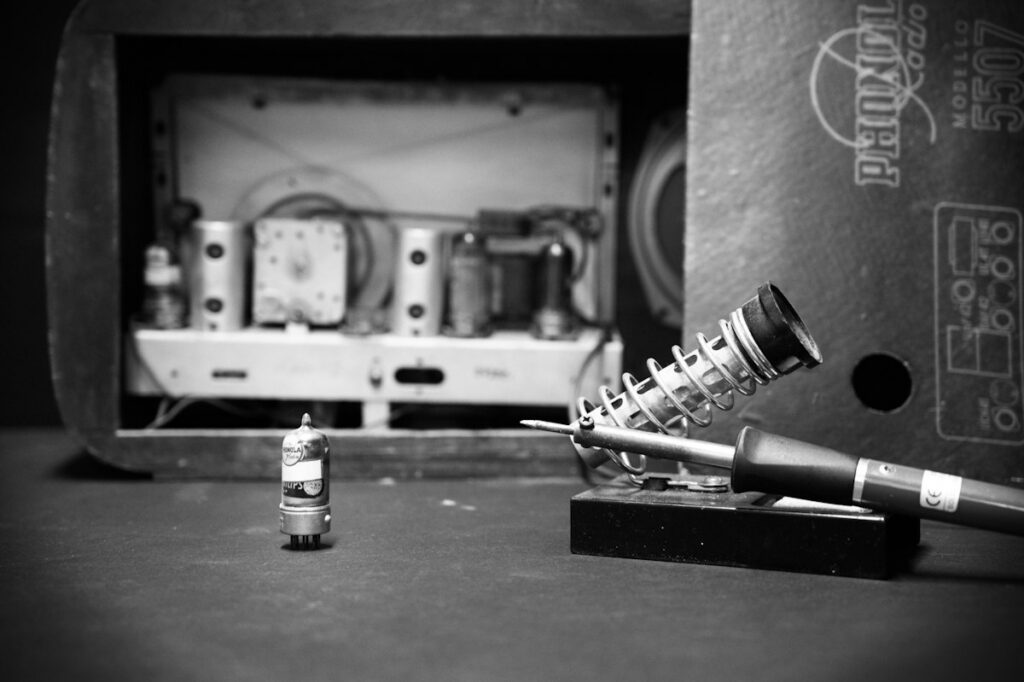
Other customers on the vintage bench are less sentimental. Tube amplifiers, still built for musicians and audiophiles, eventually need fresh tubes. Keeping one running depends on factories that still make a component most of the electronics industry left behind decades ago.
Scarcity at the factory gate
Even parts still in production can turn scarce quickly. In 2022 the Milken Institute Review reported that Russia had banned vacuum tube exports that March, in retaliation against Western sanctions. The Review wrote that most tubes in use had been made in Russia, while conceding that hard numbers were elusive. JJ in Slovakia and Psvane in China kept shipping, but both were swamped with orders. Amplifier maker Audio Research noted that its new I/50 used JJ tubes. That account describes 2022; how supply stands in November 2026 is a separate question the Review could not answer.
So the trade has a second kind of scarcity. The first comes from time. The second comes from concentration: when a handful of factories supply a niche, one export rule is enough to send the whole niche hunting for stock.
The labor behind the fix
Without factory support, a technician diagnoses machines whose makers have stopped explaining them, and often has to extract a part from a donor before fitting it into the patient. That skill is plausibly the scarcest input of all. This is an editorial judgment, not a measured fact, but it makes A-Fun’s origin notable: the founder once worked inside the company that built the product.
The tradeoff sits right on the workbench. A restoration business lives on objects nobody makes anymore, so each satisfied owner leaves slightly less for the next one. The donor pile is the company’s competitive advantage and its countdown clock at the same time.