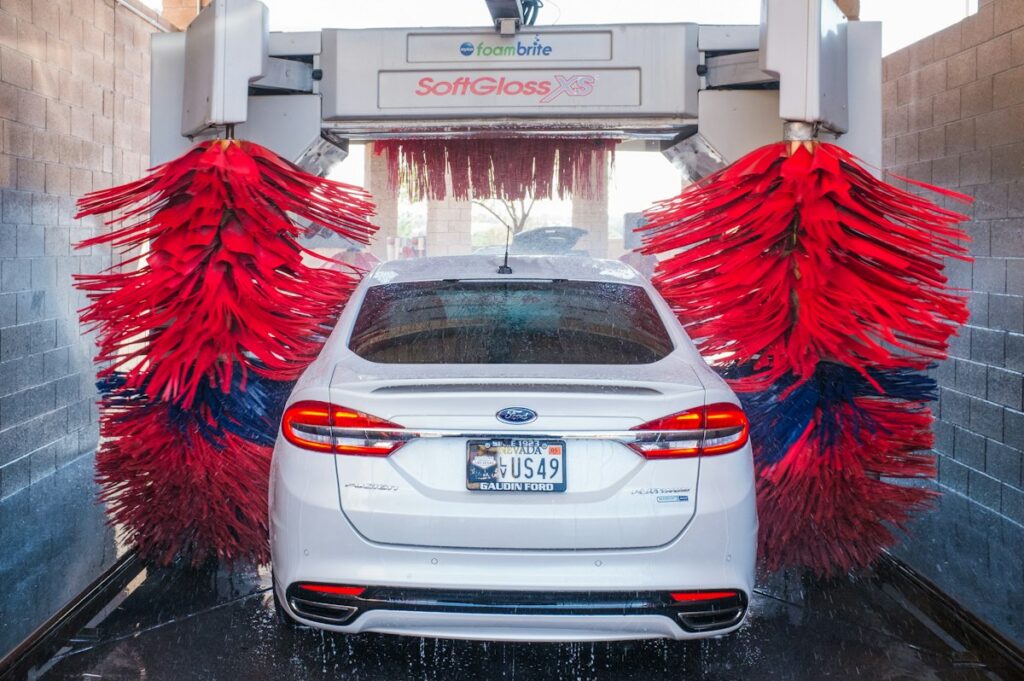
The strangest moment at many express car washes happens before any soap. A car rolls up to the entry lane and the driver does nothing. No card, no menu screen, no debate about whether the tire shine is worth it. That was settled weeks ago on a monthly plan. The small non-event is the whole subscription business in miniature. A chore people once bought irregularly and grudgingly, at whatever price was on the sign, has become a fixed charge that arrives whether the car is dirty or not.
The car wash that mostly sells memberships
Mister Car Wash describes itself as the nation’s leading car wash brand, and its own numbers show how far the model has gone. In the fourth quarter of 2025, its Unlimited Wash Club accounted for 79% of wash sales, up from 75% a year earlier, according to the company’s 2025 results. It ended that year with nearly 2.3 million members.
What follows is interpretation, not anything the filing says. A car wash carries the costs of a small factory: land, tunnels of equipment, water, chemicals, staff on every shift. Rent and payroll don’t care about a rainy week. Pay-per-wash sales swing with the weather, while membership fees arrive on schedule. For a business with fixed costs that size, a forecast is worth almost as much as a sale.
What the customer is actually paying for
The wash itself doesn’t change. A member rides through the same brushes and dryers as the driver paying at the gate. What changes is the decision. A flat fee removes the small mental math of whether the car is dirty enough to justify the price today.
Flat pricing also sorts customers, quietly. Heavy users drive their cost per wash down, and light users pay for washes they never take. The operator doesn’t need anyone to be careless, only for average use across all members to fit the price and the tunnel’s capacity. Where that balance sits is something the public releases don’t say.
Pest control already runs on a calendar
Rollins, the parent of Orkin, says in its 2025 annual filing that its pest control services are primarily recurring, on a monthly, bimonthly or quarterly basis. The company says that pattern gives it visibility into future revenue. It reported $3.8 billion in revenue for 2025, and its annual report counts more than 2.8 million customers.
The example works because the chore recurs whether anyone schedules it or not. Insects don’t read service contracts. That’s the quiet test for any chore subscription: does the problem come back on its own schedule? When it does, a monthly fee matches how life actually works. When it doesn’t, the fee has to earn its keep on convenience alone.
Recurring revenue still has to be earned
A subscription doesn’t guarantee steady income. It only makes steady income possible. Mister Car Wash’s 2024 results show membership grew just 2% that year, to over 2.1 million by December 31, 2024. By the end of 2025 it had reached nearly 2.3 million. Members move, drift away or find a closer wash. A crowded entry lane, a broken dryer or a missed pest visit makes next month’s charge a little harder to justify.
Where the subscription business strains
The feature that removes the decision also removes the reminder. A charge nobody has to approve is one nobody has to notice, and regulators have taken an interest. The Federal Trade Commission’s Click-to-Cancel Rule would have required a simple way to stop recurring charges and was due to take effect on July 14, 2025. Six days earlier, the Eighth Circuit vacated it on procedural grounds. The court did not rule on the rule’s merits. At least as of that ruling, how easy leaving should be remained an open question at the federal level.
The transaction that moved
Look closely and the service rarely changes. The wash is the same wash, and the ants are the same ants. What moves is the moment of payment. It shifts from the point of need to a date on the calendar, where it no longer competes with a windshield that looks clean enough. The customer buys one less decision, and the company buys a forecast. Each is betting the other stays predictable.
Company figures are as reported in the filings for the periods stated.