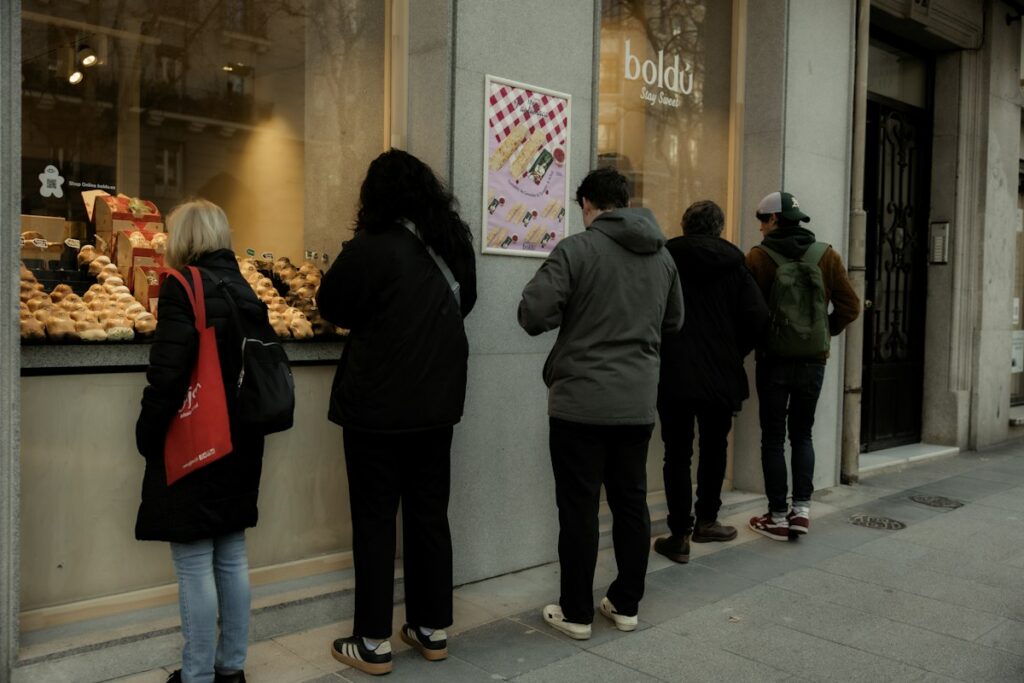
Every famous bakery line is, in a narrow technical sense, a shortfall. More people want pastry each hour than the counter can hand over, and the difference is standing on the sidewalk in a puffer jacket. That difference also does something a billboard can’t. It tells every passerby that a lot of strangers decided this croissant was worth their morning.
What a bakery line tells a stranger
Economists have a dry name for this: herding. In a 1992 paper in the Quarterly Journal of Economics, Abhijit Banerjee used a choice between two restaurants to show how it works. Each newcomer reasonably assumes the people who arrived earlier knew something, so they follow the crowd instead of their own hunch. The uncomfortable part of his model is that the crowd can settle on the worse option and stay there, because nobody new is acting on their own information anymore.
The pull may also wear off. A field study of two food stands found that newly arriving customers tended to pick the stand with the longer line in the first observation period, but not in the second (study abstract). Learning is a plausible explanation. A line persuades people who haven’t tasted the food yet. Once they have, the crowd matters less.
The counter sets the speed limit
From behind the counter, a line is a throughput problem. Take an illustrative shop with one register where each order takes 90 seconds. It serves 40 people an hour. Eighty people outside means two hours on the pavement, before anyone asks whether the almond croissants are gone.
Waits like that are not a thought experiment. In May 2026, a Parachute co-owner described waits of up to two hours to the San Francisco Standard. Shortening them is harder than it looks from the sidewalk. Laminated pastry is made in batches long before the doors open. Ovens hold a fixed number of trays. A second register means a second wage, paid even on a rainy Tuesday when nobody lines up.
The economics also invite a less flattering possibility, even where nobody admits to it. If the line is the advertisement, a slow counter starts to look like part of the media budget. A bakery doesn’t have to engineer the bottleneck for the bottleneck to earn its keep.
Why the price stays put
Textbook logic says that when demand keeps beating supply, prices should climb until the line disappears. Gary Becker took on that puzzle in a 1991 note in the Journal of Political Economy. He asked why popular restaurants, plays and sporting events so often leave prices alone despite steady excess demand. His answer rests on social influence. If part of what makes something desirable is how many other people want it, a price rise that thins the crowd can also drain the appeal. It is a model rather than a measurement, but it maps neatly onto a pastry counter.
For a bakery the point is sharper, because the product is supposed to feel within reach. Arsicault owner Armando Lacayo told the Standard that a croissant is “an everyday luxury.” A $14 croissant (an illustrative price) would certainly cut the wait. It would also make the pastry a good deal less everyday.
Moving the line onto a calendar
Dominique Ansel’s bakery offers one alternative to the sidewalk. Its Cronut pre-order system opens at 11am Eastern every Monday. It takes orders for pickup two weeks ahead and allows each person a minimum of 2 and a maximum of 12 pastries a week. The cap rations a scarce product. The calendar turns a crowd into a production schedule the kitchen can plan around.
That swap has a cost of its own. A pre-order is invisible. It reassures the person who placed it and tells nobody walking past that anything is happening behind the glass.
The bakery is left holding two levers that pull against each other. Serve faster, and its best free advertising shrinks. Keep the line, and customers keep paying in time to impress strangers. If the food-stand study is any guide, those strangers eventually stop reading the queue and start tasting. From then on the croissant has to carry the business by itself.